flowchart TB
    IRN["Iran war<br/>Hormuz"] --> USA["United States<br/>White House and Pentagon"]
    USA -->|"pressure: embargo, bases"| ESP["Spain<br/>Caretaker government"]
    USA -->|"preferred partner"| MAR["Morocco<br/>Palace and Mansouri government"]
    MAR -->|"migration control"| CEU["Ceuta"]
    MAR -->|"Tanger Med"| EST["Strait"]
    ARG["Algeria<br/>gas, Medgaz"] -->|"rivalry"| MAR
    ARG -->|"energy"| AND
    ESP --> AND["Andalusia<br/>Rota, Morón, Algeciras, agri-food exports"]
    CEU --> AND
    EST --> AND
    UE["European Union<br/>Schengen, trade"] --> ESP
    FRA["France"] -.->|"competes for Rabat"| MAR
    NE["Shipping lines, smuggling networks,<br/>digital platforms"] -.-> EST
A Triangle with Its Apex in the Bay of Cádiz
From the beach at El Palo, on an October morning, the Mediterranean looks like a domestic affair. A few jábegas hauled up on the sand, the odd swimmer refusing to give in to autumn, and the beach bars still shuttered. Nothing in that calm suggests that, a little over a hundred kilometres to the west, a three-cornered game is being played in which Andalusia supplies the board, the pieces and, in all likelihood, the bill.
The three corners have names. Washington, which since March has treated Spain like the child who refused to lend out his notes. Rabat, which has just inaugurated a new government after a summer in which Ceuta reminded us once again that a border can open without anyone signing anything. And Madrid, which dissolved Parliament on 5 October and has called elections for 29 November, so that over the coming weeks the State will be negotiating with two demanding neighbours from the comfortable position of a caretaker government, riddled with corruption cases it needs to cover up.
In this post we do not return to the July assault, which we already analysed in Ceuta After the Surge, nor to the port competition in the Strait, covered in The Strait Is Now Priced in Carbon. What interests us now is what happens when all these pieces move at once.
An isolated crisis can be managed. Three simultaneous crises in the same square kilometre of sea become a system.
The Question
We frame the question as precisely as we can:
To what extent does the convergence of the Spanish–US rift over the Iran war, Rabat’s realignment after Ceuta and the 23 September elections, and Spain’s snap election on 29 November threaten, over the next six to twelve months, Andalusia’s strategic and economic value in the Strait of Gibraltar?
Put more plainly: is whatever made southern Spain an indispensable piece now shifting to the southern shore?
What Has Happened: A Minimal Timeline
| Date | Event | Why it matters to Andalusia |
|---|---|---|
| 28 Feb 2026 | The US and Israel strike Iran; Tehran closes Hormuz and energy prices soar (Jordan News) | Rota and Morón become assets in a war, not in an agreement |
| 2 Mar | Spain bans the use of the bases and its airspace for operations against Iran (Bursa/Al Jazeera) | The Andalusian bases become the centre of the diplomatic clash |
| 3 Mar | Trump threatens an embargo: “We are going to cut off all trade with Spain” (EFE via Metro) | Olive oil, table olives and wine are put in the shop window |
| 10 Mar | Senator Graham calls for US bases to be pulled out of Spain (El Debate) | The ghost of a move to Morocco reappears |
| May | The 1988 Agreement renews automatically (El Debate) | The legal framework survives the rhetoric |
| 8 Jul | Trump orders his Treasury to prepare to cut off trade with Spain (Reuters via NST); days later he softens his tone after the NATO summit (Qué!) | The threat is suspended, not withdrawn |
| 30–31 Jul | Surge into Ceuta: tens of thousands of entries, dozens dead, Italy calls for Spain to be suspended from Schengen (AFP via Al-Monitor) | The Strait as the EU’s external border, under European scrutiny |
| 23 Sep | Elections in Morocco: the PAM wins (97 seats), the RNI collapses and the PJD rises again (Atalayar) | New interlocutor in Rabat, same Palace |
| Sep | Brent climbs back above 100 dollars after attacks in Hormuz (El Desconcierto) | The war is still alive, and with it Rota’s military value |
| 5 Oct | Sánchez dissolves Parliament; elections on 29 November. The nationality law for Sahrawis lapses (Atalayar) | One of the irritants with Rabat is removed, without anyone intending it |
A geopolitical analysis is only as good as its sources, and sources, like neighbours, have interests. This is our assessment:
| Source | Type | Reliability | Bias to bear in mind | Use in this analysis |
|---|---|---|---|---|
| Elcano Royal Institute | Secondary, think tank | High | Non-partisan but not neutral; close to the Spanish institutional outlook | Moroccan elections, Spain–Algeria–Morocco room for manoeuvre (via summaries and press: its website blocked automated reading) |
| IEEE / CESEDEN | Secondary, Defence | High | Ministry of Defence perspective | Hybrid-threat framework. Its website did not allow automated access this month: acknowledged gap |
| Atalayar | Specialised press | Medium-high | Editorial line very close to Moroccan positions; sponsors from the energy and defence sectors | 23 September results, PAM position, Spanish–US debate |
| Reuters / AFP / EFE (via reproductions) | News agencies | High | Minimal; reliance on official sources | Ceuta events, embargo, Iran war |
| maroc.ma, Tanger Med Port Authority | Official Moroccan primary sources | High on data, low on interpretation | Government communication | Electoral turnout, port traffic |
| Andalucía TRADE / Regional Government of Andalusia | Official primary sources | High on data | Interest in stressing dependence on the US market | Andalusian exports |
| Vozpópuli, The Objective, Xataka, El Debate | National press | Medium | Different editorial lines, some strongly marked | Investment in Rota, economic impact of the bases |
| Qué!, Grupo Animal | Press / opinion | Medium-low | Aggregation and opinion | Context only, cross-checked against other sources |
In line with our own criteria, we have not used RTVE, RNE, regional broadcasters or the CIS as trusted sources. Where an agency quoted figures from TVE, we preferred those from other sources.
Actors, Interests and Capabilities
| Actor | Interests | Capabilities | Current motivation | Vulnerabilities |
|---|---|---|---|---|
| US (White House) | Punish perceived disloyalty; allied spending at 5 % | Tariffs, selective embargo via IEEPA, pressure within NATO | Make an example of Spain; midterm elections on 3 November | Judicial limits on its trade policy; trade policy is negotiated in Brussels |
| US (Pentagon, US Navy) | Keep Rota as a naval hub for Europe, Africa and the Middle East | Missile-defence destroyers, maintenance contracts | An open war with Iran demands stable logistics | Morocco is not NATO territory and has no equivalent facilities |
| Spain (caretaker government) | Sovereignty, international law, border stability | EU, NATO, Armed Forces, trade weight | Reach 29 November without new crises | Reduced decision-making capacity; dependence on Moroccan cooperation |
| Regional Government of Andalusia | Protect exports and jobs in the Bay of Cádiz and the Campo de Gibraltar | Export promotion, dialogue with business | Prevent foreign policy from costing it markets | No powers over foreign affairs or defence |
| Morocco (Palace) | Sahara, regional leadership, alliance with the US, 2030 World Cup | Border control, diplomacy, network of alliances (US, Gulf, Israel) | Capitalise on Spanish weakness | Youth unemployment, “two-speed Morocco”, low urban turnout |
| Mansouri government (PAM) | Economic legitimacy, social agenda | Economic management | Show stability and good neighbourliness | Foreign Affairs and Interior remain royal domain |
| Algeria | Contain Morocco; sell gas | Energy (Medgaz lands in Almería) | Regain weight in Spain after 2022 | Dependence on hydrocarbons |
| European Union | Controlled external border, Schengen intact | Trade, funding, Frontex | Prevent political contagion from Ceuta | Internal divisions (Italy, Finland, France) |
| Non-state actors | Shipping lines (profit), smuggling networks (profit), platforms (attention), Polisario (self-determination) | Logistics, digital mobilisation | Opportunism | Regulation, police action |
An important clarification: there is no single actor in Washington. The White House talks about embargoes, while the Navy, meanwhile, tenders for tugboats and ship-repair services in Rota (Vozpópuli). The president threatens, while the admiral signs contracts. And in strategy, the contract usually weighs more than the tweet.
The Variables Moving the Board
Geography: the Map That Does Not Change
Fourteen kilometres of water separate two continents, two legal blocs and two models of State. That is the constant. Everything else (alliances, tariffs, governments) is a variable.
Military: Rota Does Not Move House with a Tweet
The idea of moving Rota to Morocco is a classic that resurfaces every time Madrid and Washington argue. The US Embassy in Rabat once denied that any offer existed to move the base to Ksar Sghir (Atalayar), and technical analyses agree that replicating Rota would require rebuilding infrastructure and legal frameworks from scratch in a country that does not belong to NATO (Xataka). The facts of 2026 point in the same direction:
The Agreement was renewed in May and the Navy is expanding services at the base.
What can shift is the marginal. Exercises, temporary deployments, newly created commands, future investment. Morocco does not need to take Rota away; it is enough to become the alternative Washington mentions whenever it wants to squeeze Madrid. And it has already achieved that.
Economic: the Andalusian Pocket
Andalusia is the second-largest exporting region to the US, with €3,138 million in 2024, 17.3 % of the Spanish total (Última Hora/Europa Press); in 2025 the figure fell to just over €2,600 million, with olive oil as the star product (Última Hora). The US is also the world’s leading buyer of Andalusian table olives (InfoAgro), a product that since 2018 has already borne a specific tariff on black olives.
A total embargo on an EU member state is legally convoluted and commercially clumsy (since trade policy is decided in Brussels), but a selective embargo on specific products is indeed an available tool, according to the lawyers consulted by Reuters (NST). And if symbolic products had to be chosen, few are more recognisable than Seville’s olives or Jaén’s olive oil.
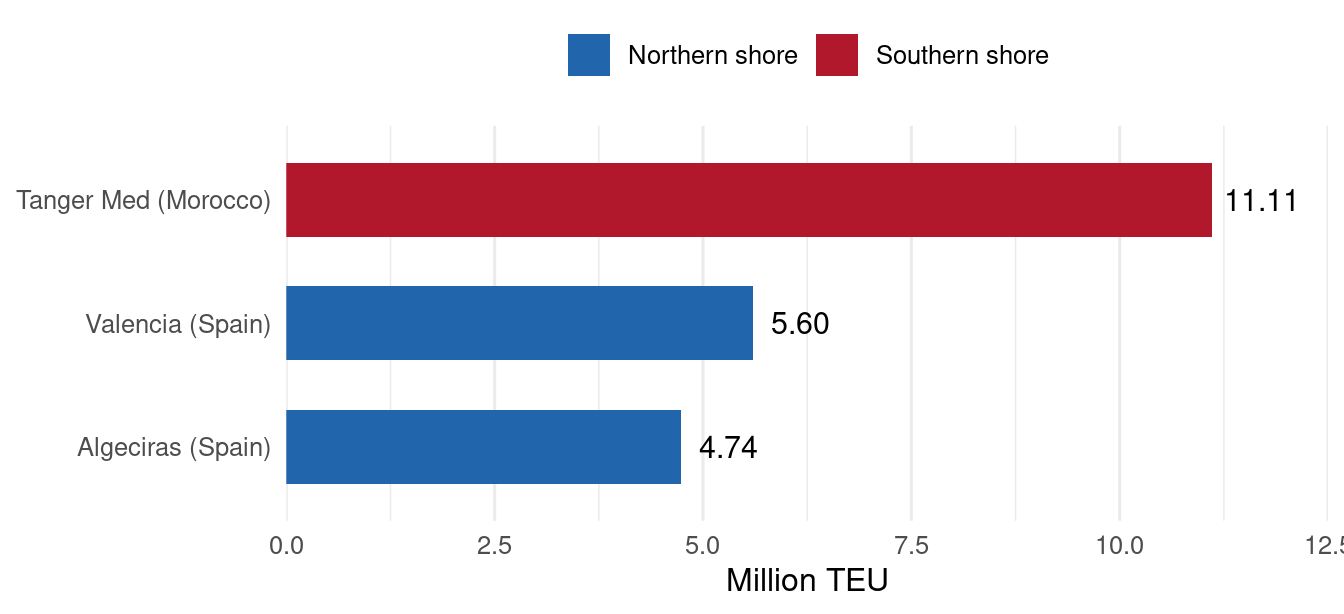
Meanwhile, the other shore keeps growing. In 2025 Tanger Med handled more containers than Algeciras and Valencia combined (El Estrecho Digital), and it already accounts for nearly half of the container traffic in the Strait’s port system, while Algeciras hovers around 20 % (El Estrecho Digital).
Energy: Hormuz Can Be Heard from Almería
The Iran war has not ended; it has become chronic. After a partial truce in the summer, the September attacks on tankers pushed Brent back above 100 dollars, and the US energy agency expects an average of around 90 dollars in the second half of the year (AFP via Connaissance des Énergies). For Andalusia this has two readings. First, that while there is war, Rota is worth more to the Pentagon, not less. Second, that Algerian gas entering through Almería gains weight, and with it the Madrid–Algiers relationship that so irritates Rabat.
Political and Technological: Two Electoral Clocks and a Mobile Phone
The calendar is diabolical. The US holds its midterm elections on 3 November; Spain votes on the 29th; Morocco is breaking in a new government. In Rabat, the PAM has won with 97 seats, Akhannouch’s RNI has collapsed from 102 to 66 and the Islamist PJD has gone from 13 to 54, on a turnout of barely 38 % (Atalayar). Fatima Zahra Mansouri, the first woman to head a government in the Arab world, has described the relationship with Spain as strategic and a priority. It is worth, however, reading the small print: the Elcano Royal Institute stresses that the result signals continuity and that, with portfolios such as Interior, Foreign Affairs or Islamic Affairs within the Palace’s orbit, the new configuration does not point to major change (Elcano). The face changes, not the hand.
The technological variable, for its part, is already familiar: in July a handful of viral videos and a badly summarised court ruling were enough to mobilise tens of thousands of people. The next crisis will not need more.
Why Now: the Window of Vulnerability
Before the surge, relations with Rabat had deteriorated over two issues:
Spain’s energy rapprochement with Algeria, and
The law granting nationality to Sahrawis born during the colonial period (Grupo Animal). On top of this, Morocco perceived its position in Washington as stronger than ever just when Spain’s was at its weakest.
With the dissolution of Parliament, the Sahrawi law has lapsed. One of the irritants disappears without anyone having to pay the political cost of withdrawing it. Rabat will chalk it up to its credit. But the other irritant, Algeria, is still there, and gas prices are rising.
The paradox of the moment is that Spain has less capacity to decide just when its neighbours have more incentive to do so.
The Elcano Royal Institute was already warning early this year that Spain is walking an ever narrower line between Morocco and Algeria, with limited room for manoeuvre (El Independiente). That line is even thinner today, because a third tightrope walker has joined it: Washington.
SWOT of Andalusia Facing the Triangle
| Favourable factors | Unfavourable factors | |
|---|---|---|
| Internal | Strengths. Irreplaceable geography; Rota and Morón integrated into NATO’s architecture and with ongoing US investment; Algeciras with experience, 100 million tonnes a year and European connections; world leadership in olive oil and olives, products the US does not produce in volume | Weaknesses. No powers over foreign affairs or defence; dependence on a politically volatile market (the US); pending rail infrastructure to Algeciras; structural unemployment in the Bay of Cádiz and the Campo de Gibraltar |
| External | Opportunities. Rota’s military value grows while the Iran war lasts; a new government in Madrid, whichever it may be, could reopen relations with Washington; the Mansouri government needs stability for the 2030 World Cup; the Ceuta crisis has Europeanised the debate on the Strait; Medgaz strengthens Almería’s energy role | Threats. Selective embargo on agri-food products; Tanger Med’s competitive and regulatory advantage; use of migration as leverage during the Spanish power vacuum; French competition for Rabat’s favour; spillover of the Iran war into the western Mediterranean |
Reading the matrix is less dramatic than the headlines suggest, but more uncomfortable than the official statements admit: Andalusia’s strengths are structural; the threats are temporary, but they coincide in time.
Scenarios to Mid-2027
We are not fortune-tellers. What follows are analytical judgements, not statistical frequencies, and we will review them every month.
Scenario A: Watchful Thaw
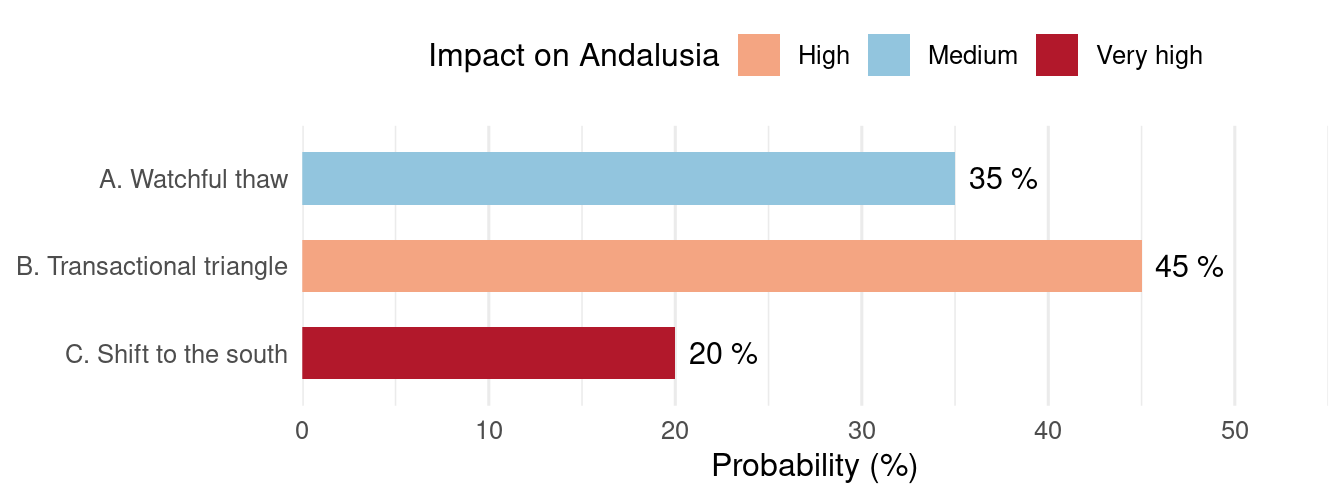
Estimated probability: 35 %
- The government that emerges from 29 November, whatever its colour, opens swift negotiations with Washington on defence spending and use of the bases within the framework of the Agreement.
- The embargo threat is shelved after the US midterms.
- Rabat, with a government focused on the economy and the World Cup, maintains migration cooperation and readmits those who entered in July.
- Rota consolidates its role; Algeciras keeps losing share, but not traffic.
Indicators: government formed in Spain before February; high-level meeting with the US; new US Navy contracts in Rota; no lists of Spanish products subject to sanctions; high-level Spanish–Moroccan meeting; low numbers of attempted entries into Ceuta.
Scenario B: Transactional Triangle
Estimated probability: 45 %
In our judgement, this is the scenario Andalusia should plan around.
- Fragmented election result and slow government formation.
- Washington keeps up the pressure with selective measures or the mere threat, enough to make US importers hold back orders.
- Morocco cooperates, but charges for it: every gesture on the Sahara, Algeria or trade comes with a price, and the border once again works as a thermostat.
- The Iran war remains unresolved and keeps energy expensive.
Indicators: prolonged caretaker government; US Trade Representative announcements on European agri-food products; decline in Andalusian exports to the US in Andalucía TRADE’s quarterly data; occasional spikes in entries into Ceuta or small boats heading for Cádiz and Almería; new gas contracts with Algeria; Moroccan statements on Ceuta and Melilla.
Scenario C: Shift to the South
Estimated probability: 20 %
- Washington turns rhetoric into action: a selective embargo on Spanish products and the transfer to Morocco of new or temporary capabilities (exercises, commands, deployments), without touching Rota’s core.
- During the power vacuum in Madrid, a new migration crisis breaks out, coinciding with an escalation in Hormuz or a decisive round on the Sahara.
- Algeciras rapidly loses calls by major shipping lines to Tanger Med.
Indicators: US executive order with a product list; announcements of US military investment in Morocco; visible relaxation of the Moroccan deployment in Fnideq; viral campaigns about an “open border”; fewer calls at Algeciras; naval tension in the Strait.
| Scenario | Probability | Impact on Andalusia | Risk |
|---|---|---|---|
| A. Watchful thaw | 35 % | Medium | Moderate |
| B. Transactional triangle | 45 % | High | High |
| C. Shift to the south | 20 % | Very high | High / critical |
Scenario C is not the most likely, but it is the only one in which all three threats line up at once. And in the Strait, as in poker, the danger is not one bad card, but being dealt three in a row.
What Andalusia Should Watch This Autumn
- The 29 November result and, above all, how long it takes to form a government.
- The result of the US midterms on 3 November and its effect on the tone towards Spain.
- Any official list of Spanish products liable to sanctions.
- US Navy contracts and investment in Rota and Morón.
- New US exercises or deployments in Morocco.
- The make-up of the Mansouri government and whether Bourita stays at Foreign Affairs.
- Attempted entries into Ceuta and arrivals on Andalusian coasts.
- Viral messages about “open borders” on Moroccan social media.
- The UN negotiating round on the Sahara.
- Gas contracts with Algeria and the state of Medgaz.
- Brent and actual traffic through Hormuz.
- Calls by major shipping lines at Algeciras versus Tanger Med.
- Andalusian exports to the US (olive oil, olives, wine) in the quarterly data.
Answering the Question
Andalusia is not losing its strategic value; it is losing bargaining power. They are two different things and should not be confused.
Its strategic value (geography, Rota, Morón, the link with NATO) is structural and, if anything, has increased with the Iran war, since the Pentagon itself proves it by investing in Rota while the White House threatens. No tweet can move a missile shield to a country that is not in the Alliance.
What is being eroded is the ability to turn that value into influence. This is happening along three simultaneous paths: a) Washington has discovered that it can punish Spain through Andalusia’s agri-food pocket without touching the bases; b) Rabat has confirmed that the border and its closeness to the US give it leverage just when Spain is in caretaker mode; and c) Tanger Med shows every quarter that geography without strategy is just scenery.
The risk for Andalusia over the next six to twelve months is therefore economic and political before it is military: selective tariffs or embargoes on emblematic products, loss of port share and episodic migration pressure. The window of greatest vulnerability runs from now until the next government is formed, probably in early 2027.
The Strait has always been worth the same. What changes is who knows how to cash in on it.
By Way of Conclusion
From El Palo, the Strait is sensed more than seen. It lies to the west, behind the curve of the coast, like those matters one knows to be important but puts off until after the elections. The problem is that our neighbours have no elections to wait for: the Palace in Rabat thinks in decades and the Pentagon in fleets. Only Madrid’s paralysed, corruption-ridden government thinks in terms of legislatures, whatever the cost and by whatever means (holding on to the seat for the sake of it).
Andalusia cannot sign treaties or move destroyers, but it can do something it often forgets: measure, anticipate and demand. Measure its dependencies, anticipate the pressures and demand that whoever governs in Madrid from December onwards treat the Strait as what it is, the most valuable border in Europe, and not as a matter remembered only when the images from Ceuta arrive.
Main Sources
| Source | Use in this analysis |
|---|---|
| Elcano Royal Institute | Reading of the Moroccan elections; room for manoeuvre between Morocco and Algeria |
| Atalayar | 23 September results, position of the PAM and Mansouri, dissolution of Parliament, Spain–US debate |
| Reuters, AFP, EFE (via reproductions) | Ceuta crisis, embargo orders, Iran war |
| maroc.ma and Tanger Med Port Authority | Official electoral and port data |
| Andalucía TRADE / Regional Government of Andalusia | Andalusian exports to the US |
| Vozpópuli, Xataka, El Debate, The Objective | Investment in and economic value of Rota and Morón |
| El Estrecho Digital, Container Magazine | Algeciras–Tanger Med competition |
| Voces de El Palo | Background: Ceuta 2026, the Strait and carbon, Iran and Málaga |
Methodological Note
This analysis distinguishes three levels of certainty:
- Verified facts: data backed by news agencies, official sources or several independent sources (election results, timeline, port traffic, exports).
- Indications: plausible information from a single source or an interested source (for example, the real extent of Trump’s change of tone after the NATO summit).
- Analytical hypotheses: interpretations and scenarios, including probabilities, which are judgements rather than measurements.
This month it was not possible to consult IEEE/CESEDEN publications directly, as their website does not allow automated reading, nor the full text of some Elcano analyses. It is a gap that should be filled in the next review.
Disclaimer: this text is a geopolitical and forward-looking analysis. The assessments, hypotheses and probabilities expressed are analytical judgements and not statements about unproven facts.