flowchart LR
    SAH["Sahel<br/>instability and migration"] --> MAR["Morocco"]

    ARG["Algeria<br/>energy and regional rivalry"] --> MAG["Maghreb balance"]
    MAG --> MAR

    MAR -->|"migration control"| CEU["Ceuta / Melilla"]
    MAR -->|"Tanger Med"| EST["Strait"]
    MAR -->|"energy and interconnections"| AND["Andalusia"]

    CEU --> AND
    EST --> ALG["Bay of Algeciras"]
    ALG --> AND

    AND --> ESP["Spain"]
    ESP --> UE["European Union"]

    OTR["Other interested<br/>actors?"]  -.->|"possible influence"| RRSS["Social media<br/>information and disinformation"]
    RRSS --> CEU
When Africa Is Fourteen Kilometres Away
Maps have a curious ability to mislead us. Africa appears below, Europe above, and between them lies a blue strip called the Mediterranean. It seems enough to keep everything in its place, but appearances are deceptive. At the end of July 2026, between 50,000 and 72,000 people — estimates vary depending on the source and the stage of the count — surged into Ceuta from Morocco within a matter of hours. Reuters later placed the Spanish figure at around 72,000 entries and reported that approximately 70,000 had already returned to Morocco. Associated Press described the episode as the largest migration surge between Morocco and Spain in recent years, with dozens of deaths.
This was therefore no mere border incident. And for Andalusia, it would be a mistake to regard it as an issue concerning Ceuta alone. Algeciras, Tarifa, Cádiz, Málaga, the Campo de Gibraltar and Andalusia’s major logistics corridors form part of the same geographical system as Tangier, Tetouan and Ceuta. What happens on the other side of the Strait quickly stops being “Morocco’s problem” and becomes a Spanish problem — and, with particular intensity, an Andalusian one.
This mass influx has exposed a serious structural vulnerability for Spain in relation to Morocco. Although there is no definitive evidence that Morocco deliberately organised the surge, there are indications that it may have allowed the situation to develop. This raises a more troubling question: could the episode, deliberately or otherwise, have served to test what would happen in the event of a much more serious crisis involving the city? The precedents of Perejil in 2002 and Ceuta in 2021 mean that the question is not entirely speculative. Morocco may not be a declared enemy of Spain, but neither is it an NGO. It is a state with interests, objectives and ambitions, and a monarchy that has pursued an extraordinarily pragmatic foreign policy for decades. It cooperates when cooperation serves its interests and increases pressure when it believes that doing so will improve its position. Exactly as states do when they can afford to.
The problem is not that Morocco has interests. The problem begins when Spain forgets that it does.
What We Know So Far
The episode was linked, at least in part, to messages and rumours spread through social media, to a particularly difficult socio-economic situation among many young Moroccans, and to legal circumstances that temporarily reduced the deterrent capacity of the authorities. Reuters documented both the mobilisation through social media and the Moroccan explanations regarding the consequences of a judicial ruling in Spain.
The Financial Times reported on 11 August that Moroccan youth unemployment was close to 37%, alongside a widening gap between major public investments — including those linked to the 2030 World Cup — and the economic opportunities perceived by many young people. This domestic variable matters, because not every mass migration movement requires a geopolitical puppeteer, although the advantages Morocco may derive from such a situation should not be ignored.
The Spanish government, for its part, publicly defended Moroccan cooperation, stating on 30 July that Spain maintained exemplary cooperation with Morocco on migration and attributing a central role to human-smuggling networks and to the exploitation of a judicial ruling. That official position contrasts, however, with later reports according to which Spanish intelligence services believe that Morocco did not organise the surge but did allow it to happen.
According to El País and Cadena SER, citing sources familiar with the analyses of the Spanish intelligence services, those services concluded that Morocco had not planned the surge but had allowed it to happen, in a context in which border controls had gradually been relaxed during July.
In any event, Spain needs Morocco to be a reliable partner. Yet recent history has shown that Morocco is willing to use the border issue as an instrument of pressure when it believes its interests are at stake, as happened particularly clearly in 2021. Spain therefore has a degree of dependence on Morocco, giving Rabat considerable leverage. Dependence does not prove hostility on the part of a partner, but it remains dependence.
Before Ceuta Came the Green March
The subtitle of this article is not intended to suggest that Morocco is literally preparing a new Green March on Ceuta. There is no evidence for such a claim. History does, however, provide precedents that justify the comparison as an analytical tool.
In November 1975, while Spain was going through one of the weakest political moments in its recent history, Hassan II, then King of Morocco, launched the Green March into what was then Spanish Sahara.
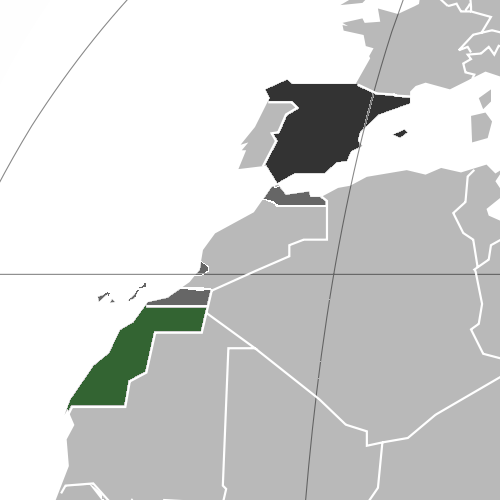
Source: VoodooIsland at English Wikipedia, Public domain, via Wikimedia Commons
It was not simply a spontaneous gathering of enthusiastic civilians. The Elcano Royal Institute recalls that, under the appearance of a civilian mobilisation, the operation combined political pressure and military deployment at a moment of maximum Spanish weakness, helping to force a negotiated withdrawal with remarkable speed.
It was an example of how armoured vehicles are not always necessary to alter a strategic situation. Sometimes it is enough to create a fait accompli, force the other side to react, and place upon it the political, diplomatic and human cost of that reaction. The use of a mass civilian mobilisation also placed Spain in an extraordinarily difficult dilemma, since any military response against an unarmed crowd would have entailed potentially enormous human, political and diplomatic costs.
The most intelligent operations are those in which the adversary appears to be the one making all the decisions.
The Green March belongs to a different historical and territorial context. There is nevertheless a similarity in the strategic principle: using a mass civilian mobilisation to create a situation that overwhelms normal response mechanisms and forces the other side to choose between unpalatable alternatives. Fifty years later, technology, social media and Europe’s borders allow us to imagine more sophisticated variants.
Perejil, 2002: The Fait Accompli
There is another precedent that Spain spent years turning into an almost comic story about a lump of rock, some goats and a few soldiers, although the affair was considerably more serious.
On 11 July 2002, Moroccan forces occupied Perejil Island, located a short distance from the North African coast and very close to Ceuta. The island’s economic importance was negligible. Its strategic importance lay precisely in its location and its disputed status, since Spain considered it unacceptable for Morocco to alter the status quo unilaterally through an occupation.
The Elcano Royal Institute describes the occupation of Perejil as the culmination of a serious bilateral crisis and notes that Morocco once again resorted to a policy of fait accompli.
Ceuta, 2021: Discovering Another Lever
Nineteen years later, under the current government, a different instrument appeared. In May 2021, amid the serious diplomatic crisis triggered by the hospitalisation in Spain of Polisario Front leader Brahim Ghali, thousands of people crossed from Morocco into Ceuta. Estimates generally range between 8,000 and 10,000 people. Reuters recalls that Moroccan controls appeared to be relaxed during that crisis, while the Elcano Royal Institute has been even more explicit in describing the episode as an example of the use of migration flows as an instrument of political pressure.
The mechanism was much more sophisticated, less conventional than Perejil, and more similar to the Green March:
In 2002 there were soldiers.
In 2021 there were civilians.
As in 1975, while a small military contingent occupying an island can be met with another military contingent, when 10,000 people are involved — including many minors — the range of possible responses is constrained by law, ethics, the media, European institutions and public opinion itself.
Force still exists, of course, but using it becomes politically much more costly. A new lever had therefore appeared.
Perejil tested Spain’s territorial and military response. Ceuta in 2021 tested its political, policing, legal, humanitarian and media response.
How July 2026 Unfolded
Several circumstances converged in July 2026. For at least a week, messages had been circulating on Facebook, TikTok, Instagram and WhatsApp claiming that the border with Spain was open or that entering by swimming offered new possibilities of remaining in Spanish territory. The Elcano Royal Institute considers that social media played a clear mobilising role and notes that the extraordinary number of participants and their arrival from different parts of Morocco make it difficult to explain the phenomenon as something entirely spontaneous and devoid of planning.
The starting point was a ruling by the Spanish Supreme Court, a simplified interpretation of which circulated widely in messages encouraging crossings. The ruling established that people intercepted at sea while attempting to reach Ceuta or Melilla by swimming could not be subjected to the special border-rejection procedure designed for those attempting physically to breach border installations, but instead had to be dealt with under the ordinary return procedure. It did not mean that anyone who reached the water had discovered a safe-conduct pass to settle in Spain. But laws rarely survive intact once they reach TikTok.
The simplified and distorted interpretation of the Spanish Supreme Court ruling became something like: if you get there by swimming, they cannot send you back.
Thousands of people acted accordingly from Morocco. A country that the Financial Times has described as an economy modernising infrastructure, developing industries and preparing major projects linked to the 2030 World Cup, yet unable to translate that growth into prospects for a large proportion of its young people. Youth unemployment stands at around 37%, several times the overall rate, and continues to fuel the desire to emigrate.
Not everything, therefore, requires a puppeteer. Tens of thousands of young people may genuinely want to leave. Relative poverty, frustration, expectations, social media and the pull factor can explain a very substantial part of what happened. But explaining why someone wants to cross a border does not necessarily explain why the border stops preventing them from doing so.
Analysing these episodes as separate events reveals an interesting sequence.
| Episode | Instrument | Main dimension tested |
|---|---|---|
| Green March, 1975 | Civilian mobilisation backed by state and military pressure | Spain’s political capacity to resist a large-scale fait accompli |
| Perejil, 2002 | Limited territorial occupation | Military capability and political willingness |
| Ceuta, 2021 | Migration pressure during a diplomatic crisis | Policing, humanitarian, political and European response |
| Ceuta, 2026 | Rapid mass movement of people | Ceuta’s coping capacity and Spanish and European response capacity |
No single piece of evidence proves the existence of a continuous strategy. Yet all these episodes generate learning for Morocco, Spain — although some recent statements by ministers suggest that they are incapable of learning anything (see report) — and Europe. The European Commissioner for Migration, Magnus Brunner, has warned of the vulnerability created by depending on the goodwill of neighbouring states to control external borders. Relations between Spain and Morocco need to function because there is deep interdependence in trade, security, migration, counter-terrorism and energy. The problem arises when that interdependence becomes a dependency that can be used as an instrument of pressure.
Actors and Interests
Many actors are involved in this situation (see chart and table).
It would be a mistake to analyse these actors as independent pieces, because they interact continuously. A decision on Western Sahara, for example, can have consequences in other areas of the bilateral relationship. Spain’s 2022 shift — decided by Pedro Sánchez without prior debate in Congress — altered a central element of the relationship with Morocco and simultaneously affected relations with Algeria. A judicial ruling, meanwhile, can be transformed into a fifteen-second video capable of mobilising thousands of people, with Rabat’s acquiescence and the indifference of Spain’s governing authorities.
| Actor | Main interest | Capabilities | Vulnerabilities |
|---|---|---|---|
| Spain | Maintaining sovereignty, border stability and cooperation with the Maghreb | Armed Forces, Guardia Civil, diplomacy, EU, commercial weight | Partial dependence on Moroccan cooperation |
| Morocco | Regional consolidation, Western Sahara, economic development and influence over its surroundings | Territorial control, migration, diplomacy, trade, security | Youth unemployment, inequality, social pressure |
| Andalusia | Stability of the Strait and economic and logistical continuity | Ports, infrastructure, geographical position | Immediate exposure to any crisis in the Strait |
| European Union | Protection of the external border and Mediterranean stability | Market, funding, trade, visas, cooperation | Partial externalisation of migration control |
| Algeria | Preventing Moroccan predominance in the Maghreb | Energy, diplomacy, military power | Regional rivalry and Morocco’s isolation |
| Criminal networks | Economic profit | Human networks, information and logistics | Police action and international cooperation |
| Digital platforms | Commercial activity and circulation of content | Capacity for instant mobilisation | Regulation and institutional pressure |
Spain also possesses significant military and security capabilities in the area and belongs to both the European Union and NATO. At Perejil, it demonstrated that it has the capacity to respond militarily to a limited territorial alteration. CESEDEN’s analysis continues to regard this capability as an important component of Spanish deterrence.
Nevertheless, Spain has serious weaknesses in this area.
The first is the most obvious. Spain is unable to guarantee control of its southern border entirely on its own. It needs Moroccan cooperation.
The second is political. CESEDEN has pointed to the lack of continuity and clarity in Spain’s strategy regarding Moroccan claims over Ceuta and Melilla, as well as the frequently reactive nature of Spanish policy.
The third concerns information. The July crisis showed that tens of thousands of people can be mobilised in an extraordinarily short period through social media, while institutions try to determine who started the campaign, who amplified it and who simply decided to take advantage of it.
Despite all this, there are avenues for correction and opportunities arising from the situation. One is the opportunity to press for the definitive Europeanisation of security in the Strait. Ceuta is not merely a peripheral Spanish border; it is the European Union’s external border with Morocco. The crisis has triggered an intense European debate about the consequences that a breakdown in external-border control can have for the functioning of the Schengen area.
A second opportunity is to develop early-warning systems specifically for Andalusia, Ceuta and Melilla. It is not enough to count migrants once they have arrived; it is necessary to monitor:
- trends on social media;
- movements in northern Moroccan cities;
- changes in Moroccan police deployments;
- official rhetoric;
- diplomatic crises;
- socio-economic indicators;
- the activity of criminal organisations;
- disinformation campaigns.
The third is to stop thinking of the Strait exclusively as a border. It is also a platform for economic and energy cooperation, which requires reducing vulnerabilities without breaking relations with Morocco. This means ensuring that no indispensable relationship becomes a unilateral dependency.
There are, however, important obstacles to overcome:
- Migration pressure.
- Commercial closures.
- Disinformation.
- Cyber operations.
- Espionage.
- Faits accomplis.
CESEDEN explicitly includes among potentially hybrid precedents involving Morocco the closure of the commercial border with Melilla, disinformation operations, the Pegasus case — which affected, among other public officials, the Prime Minister of Spain — and the instrumentalisation of migration in May 2021. All of this belongs to what is commonly known as the grey zone.
So, Was July 2026 a Rehearsal?
We cannot know, and that is probably precisely what makes the phenomenon so interesting. There is not enough public evidence to claim that the Moroccan government deliberately planned and executed the surge, although there are sufficient indications to keep open the hypothesis that Rabat allowed the situation to develop. It is therefore unreasonable to dismiss the strategic utility Morocco may have extracted from the episode, since it allowed Rabat to observe:
- how long Spain took to mobilise forces;
- how many people could enter Ceuta before the border was stabilised;
- how much accommodation capacity was available;
- how the courts reacted;
- how long the European Union took to intervene;
- which European states showed solidarity and which acted unilaterally;
- what role social media played;
- what domestic political cost the Spanish government suffered;
- and how quickly normality could be restored through cooperation with Rabat.
All of that is information, and in strategy, information obtained without firing a shot is usually the cheapest kind. This is why the word rehearsal should perhaps be understood in a broad sense. Not necessarily as an operation prepared in advance, but as an opportunity to investigate what happens. In this way one observes, learns and files the information away.
With all this accumulated learning, it seems advisable to abandon the image of a future invasion of Ceuta involving armoured divisions crossing a border. It is more likely to involve resources drawn from the grey zone:
- It could begin with something far more ambiguous, such as thousands of people advancing towards the border.
- Demonstrations in Spanish cities calling for Ceuta and Melilla to be handed over to Morocco.
- Border incidents designed to provoke the use of force by Spanish security forces, readily marketable as acts of aggression in sympathetic media.
- Possible military-related problems involving people with dual Spanish-Moroccan nationality.
- Digital disinformation campaigns.
- Customs problems.
- A diplomatic crisis with Morocco coinciding with disputes involving other countries that have clashed with Spain’s current government, such as Russia, the United States, Israel and others.
- A small fait accompli, then another, and another — each one insufficient to justify an extraordinary response, but collectively capable of gradually altering the environment.
The next Green March might not have green flags, trucks or perfectly organised columns. It may need nothing more than mobile phones, social desperation and a border that someone decides to guard a little less carefully.
This does not mean that it will happen. It means that Spain should be prepared precisely so that it cannot happen — provided, of course, that the political will exists.
Deterrence works when the adversary knows that the cost of testing will be greater than the expected benefit. Not when it discovers the response only after conducting the test.
Possible Scenarios
We are neither fortune-tellers nor futurologists. We are simply setting out possible scenarios and the signals that should be monitored.
Scenario A: Stable Interdependence
Estimated probability: 45%
- Spain and Morocco maintain intense cooperation.
- Rabat strengthens border controls.
- Madrid avoids unnecessary tensions.
- The European Union increases its involvement.
- Economic relations continue to expand and neither side has sufficient incentives to provoke a serious crisis.
- There would be no friendship, but rather mutual interest — which in international relations is often more reliable.
Indicators:
- continued reduction in attempted crossings;
- strong Moroccan police presence;
- regular bilateral meetings;
- cooperation on returns;
- absence of rhetorical escalation over Ceuta and Melilla;
- maintenance of economic and security relations.
Scenario B: Cooperation with Periodic Crises
Estimated probability: 40%
This is probably the scenario Andalusia should use as the main reference for its planning.
- Spain and Morocco cooperate most of the time. But the cooperation becomes transactional.
- When a dispute arises — Western Sahara, fisheries, customs, European policy, relations with Algeria — episodes of limited pressure emerge.
- The relationship is not broken; its temperature is regulated, and the border can once again become the thermostat.
Indicators:
- temporary relaxation of controls;
- sudden increases in digital messages about border crossings;
- border incidents;
- diplomatic campaigns over Ceuta and Melilla;
- commercial blockades;
- tensions linked to Western Sahara;
- simultaneous movements towards Ceuta, Melilla or the Andalusian coast.
Scenario C: Strategic Crisis
Estimated probability: 15%
A serious political or territorial dispute damages the bilateral relationship.
Different instruments of pressure are combined:
migration;
disinformation;
maritime incidents;
cyberattacks;
economic pressure;
protests;
territorial claims.
Spain responds by increasing its military presence and requesting European and Atlantic support.
A war would not necessarily occur, precisely because the aim of a hybrid strategy is to achieve results before reaching that point.
Indicators:
- visible reduction in Moroccan border-control forces;
- increasingly assertive official rhetoric on Ceuta and Melilla;
- suspension of bilateral mechanisms;
- extraordinary military movements;
- coordinated disinformation campaigns;
- maritime incidents;
- simultaneous pressure across different domains.
The probabilities above are not statistical frequencies; they are analytical judgements and should be reviewed periodically as new evidence emerges.
Risk Matrix
| Scenario | Probability | Potential impact on Andalusia | Risk |
|---|---|---|---|
| Stable interdependence | 45% | Medium | Moderate |
| Cooperation with periodic crises | 40% | High | High |
| Strategic crisis | 15% | Very high | High / critical |
The least likely scenario is not necessarily the least important. In risk management, black swans have the unpleasant habit of failing to consult the statistics before they appear.
What Andalusia Should Monitor
Andalusia has no constitutional powers over foreign policy or defence, but that does not mean it can afford to ignore them. The consequences of a crisis in the Strait would directly affect its ports, roads, public services, businesses, security forces and municipalities. It would therefore be reasonable to maintain a permanent strategic-monitoring system based, at a minimum, on the following indicators:
- Attempts to enter Ceuta and Melilla.
- Arrivals on the Andalusian coast.
- Changes in Moroccan police deployments in Fnideq and other border areas.
- Viral messages relating to border openings.
- Identification of accounts that originate and amplify those messages.
- Youth unemployment and social protests in Morocco.
- Official statements on Ceuta, Melilla and Western Sahara.
- Developments in Morocco-Algeria relations.
- Extraordinary military movements in northern Morocco.
- Changes in Madrid-Rabat diplomatic relations.
- Maritime incidents in the Strait.
- European decisions on migration and cooperation with Morocco.
- The state of cross-border trade.
- Developments in logistics and energy infrastructure in the Strait.
This is not about seeing conspiracies in every small boat. It is exactly the opposite: having enough information to distinguish a small boat from a strategic signal. Andalusia’s security in the twenty-first century will not depend solely on regional budgets, agriculture, tourism, universities or new metro lines. It will also depend on developments that appear to take place elsewhere, as well as on the capacity to distinguish a spontaneous crisis from one that is conveniently exploited.
In Voces de El Palo, when analysing the Sahel, we already warned that what happens thousands of kilometres away eventually reaches Spain’s shores. Geography has that unpleasant habit of ignoring our administrative borders. Ceuta now allows us to add a second warning.
When the Maghreb coughs, Andalusia does not need to consult the weather forecast; it can hear it from the other shore.
By Way of Conclusion
After all of the above, we can conclude that we still do not know who set in motion all the mechanisms that led to the July 2026 surge. It may be understood as an emergent social phenomenon driven by multiple factors, including the frustration of young Moroccans, an interpretation of a Spanish court ruling, the willingness of third countries to interfere, and so on. Yet there are reports, attributed to analyses by the Spanish intelligence services, according to which Rabat allowed the episode to unfold.
We may not know the details, but we know the outcome:
- In 1975 Morocco learned something about Spain’s ability to resist a mass civilian mobilisation backed by state pressure.
- In 2002 it learned about Spain’s military willingness in response to a territorial fait accompli.
- In 2021 it learned how Spain reacted when pressure came in the form of thousands of civilians.
- In 2026 it has been able to observe what happens when those thousands become tens of thousands and mobilisation occurs at the speed of a social network.
The question is whether Spain has learned the same lesson. Because history rarely repeats itself exactly.
Main Sources Used in This Analysis
| Source | Usefulness for the analysis | Assessment |
|---|---|---|
| Reuters | Chronology, scale of the crisis, casualties, Spanish and European reactions, and later reports on possible Moroccan behaviour | |
| Elcano Royal Institute | Analysis of Ceuta 2026, the 2021 precedent, the Green March, Perejil and Spain-Morocco relations | |
| IEEE / CESEDEN | Deterrence, Moroccan claims over Ceuta and Melilla, Perejil and hybrid threats | |
| Financial Times | Morocco’s economic and social situation, especially among young people | |
| Associated Press | Independent corroboration of the scale, casualties and human dimension of the crisis | |
| Atalayar | Specialist coverage of the Maghreb and Spain-Morocco relations | |
| Voces de El Palo | Previous editorial analysis of the geopolitical impact of the Maghreb and Sahel on Spain and Andalusia; a contextual and stylistic reference rather than a primary source |
Methodological Note
This analysis deliberately distinguishes between three levels of certainty:
Verified facts. Information supported by several sources or by institutional sources and international news agencies.
Indications. Plausible information from journalistic reporting or indirectly cited intelligence sources, but for which complete public documentation is not yet available.
Analytical hypotheses. Interpretations intended to explain events or anticipate future scenarios.
The possibility that the July 2026 crisis functioned as a test, an opportunistic exploitation or a mechanism for strategic learning belongs to this last category. It does not constitute a proven claim about the intentions of the Moroccan government. That is precisely why it is useful as a hypothesis. Foresight does not consist in turning suspicions into facts. It consists in asking what would happen if those suspicions were true, identifying indicators capable of confirming or refuting them, and preparing before reality decides to settle the argument for us.
Disclaimer: this text is a geopolitical and foresight analysis. The assessments, hypotheses and probabilities expressed here represent analytical judgements and do not constitute claims about unproven facts.